Regulatory Return Preparation Assistant
Prepare RBI return workings from core banking and GL extracts, run validation and variance checks before upload, and draft explanations that reporting teams review and sign off.
- Capability:
- Document Intelligence
- Industry:
- Banking
Who it is for
- Head of Regulatory Reporting
- Chief Financial Officer
- Chief Compliance Officer
- Financial Controller
The problem
Banks file a long calendar of returns to RBI, from Form A and Form VIII to BSR, ALM and large-credit reporting, many of them through the CIMS portal. The figures come from core banking, treasury and GL systems, but the mapping from source data to each return line often lives in spreadsheets and in the heads of a few people.
Mappings held in personal workbooks
The logic that turns GL heads and CBS fields into return lines sits in spreadsheets, so every change of staff or format is a risk.
Late discovery of validation failures
Validation errors and cross-return inconsistencies are often found at upload time, close to the deadline.
Variance explanations written from scratch
Each period, analysts trace large movements back to accounts and transactions and write the commentary by hand.
Circular changes that ripple through returns
When RBI revises a return format or definition, teams must work out which data elements, mappings and returns are affected.
What we build
We build a preparation assistant around your existing reporting process. A language model reads the return instructions, RBI circulars and your internal mapping notes, and helps the team keep a documented map from each return line to source fields and GL heads. The figures themselves are computed by version-controlled SQL against CBS, treasury and GL extracts, never by the model. Before upload, the assistant runs format validations, cross-return consistency checks and period-on-period variance tests, then drafts explanations for material movements by drilling into the underlying accounts. When a circular changes a return, it lists the affected lines and mappings for the team to update.
- Searchable library of return instructions, circulars and mapping notes with cited answers
- Documented line-to-source mapping for each return, versioned with maker-checker approval
- Return figures computed by reviewed SQL, never by the language model
- Pre-upload format validation and cross-return consistency checks
- Variance analysis with drill-down to GL heads and large accounts, plus drafted commentary
- Change-impact list when an RBI circular amends a return format or definition
How it works
- 01Pull source extractsPeriod-end extracts from CBS, treasury and the GL are loaded into a reporting staging area and reconciled to control totals.
- 02Compute return linesReviewed SQL mappings compute each return line, and every figure keeps a link to its source query and accounts.
- 03Validate and compareFormat rules, cross-return checks and variances against prior periods identify the items that need attention.
- 04Draft explanationsFor material variances, the assistant drills into contributing accounts and drafts commentary with references.
- 05Reviewer sign-offThe reporting analyst and the approving officer review figures, flags and commentary before anything is finalised.
- 06Prepare the upload packageThe approved return is formatted for CIMS or the bank's reporting tool, and the evidence pack is archived.

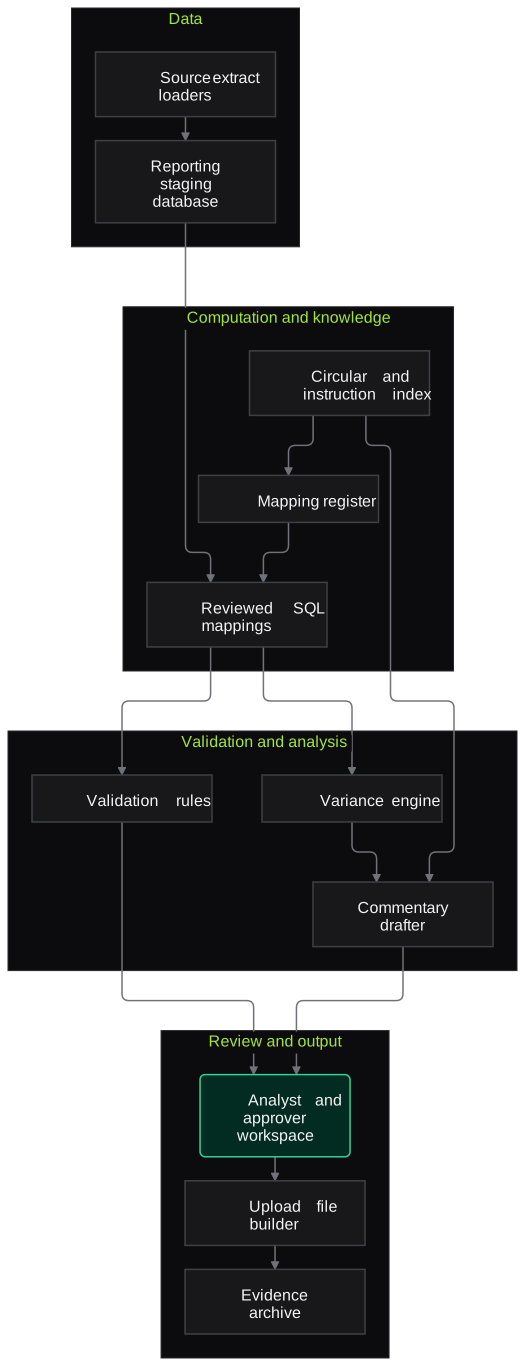
Architecture
- Data
- CBS, treasury and GL extract loaders
- Reporting staging database
- Control-total reconciliation
- Computation
- Version-controlled SQL mappings per return line
- Mapping register with maker-checker approvals
- Knowledge
- Indexed return instructions and RBI circulars
- LLM question answering with citations
- Circular change-impact analyser
- Validation and analysis
- Format and cross-return validation rules
- Variance engine with drill-down
- Commentary drafter
- Review and output
- Reviewer workspace with sign-off
- Upload file builder
- Evidence archive
Inputs and outputs
Inputs
- Period-end CBS, treasury and GL extracts
- Return templates and RBI reporting instructions
- RBI circulars and master directions relevant to each return
- Existing mapping workbooks and prior-period returns
- Internal reporting policy and materiality thresholds
Outputs
- Computed return lines with source traceability
- Validation and cross-return exception list
- Variance analysis with drafted commentary
- Change-impact list for amended returns
- Signed-off evidence pack per return and period
Where people stay in control
Reporting analysts review every exception and variance explanation, and the designated approving officer signs off each return. The assistant never submits a return; upload stays a controlled manual step.
Integrations
- Core banking system and GL (read-only extracts)
- Treasury system
- Existing regulatory reporting tool or data warehouse
- RBI CIMS upload formats
- Document repository for circulars and policies
Guardrails
- Figures come only from reviewed SQL; the language model cannot change a reported number
- Mapping changes require maker-checker approval
- Every commentary sentence links to the accounts or data it describes
- Read-only access to source systems
- Full version history of mappings, figures and sign-offs
Compliance notes
- Designed to support RBI's expectation of accurate, timely returns and its push towards automated data flow from source systems.
- Keeps the evidence trail that internal audit and RBI inspection teams ask for when reviewing how returns were prepared.
A typical pilot
Duration: 4 weeks
Two returns chosen with the reporting team, typically one balance-sheet return and one liquidity return, rebuilt for two or three past periods and compared with what was filed.
Deliverables
- 01Documented line-to-source mapping for the pilot returns
- 02Reviewed SQL computations with traceability
- 03Validation and variance checks with drafted commentary
- 04Reconciliation report against filed returns
- 05Plan for extending to the wider return calendar
What we measure
- Line-level agreement with filed returns
- Each computed line compared with the figure filed for the same period, with every difference explained.
- Issues caught before upload
- Issues the checks raise compared with those historically found at upload or through RBI queries.
- Commentary usefulness
- Analysts rate each drafted explanation as usable, needs edits or wrong.
- Preparation effort
- Analyst hours logged for the pilot returns compared with the team's usual effort.
FAQs
01Will a language model calculate our regulatory figures?
No. Figures are produced by version-controlled SQL that your team reviews and approves. The language model reads instructions, helps document mappings and drafts commentary, and it cannot alter a computed figure.
02Does it file returns on CIMS?
No. It prepares an upload-ready file and an evidence pack. Upload and submission remain controlled steps carried out by authorised staff.
03Our data sits across several systems. Is that a problem?
That is the usual situation. The pilot starts from the extracts your team already uses, reconciles their totals and documents where each field comes from, which is useful even before any automation.
04Can it keep up with new circulars?
When a circular is added to the library, the assistant lists the returns, lines and mappings that refer to the affected terms, for your team to confirm. Interpretation of the circular stays with compliance and reporting staff.
Related use cases
- Banking
AI Governance Evidence Pack for Banks
Inventory the bank's AI and ML systems and assemble the evidence boards, auditors and supervisors ask for: purpose, data, testing, monitoring, incidents and accountable owners.
- Banking
Trade Finance Document Checking (LCs, Bills of Lading)
Examine LC presentations against the credit terms, UCP 600 and ISBP, and give trade operations a draft discrepancy list with every finding tied to a document and clause.
- Banking
Customer Complaint Triage and Routing
Classify complaints from email, branches, social media and RBI CMS, spot urgent cases such as unauthorised transactions, route them to resolver teams and draft acknowledgements.
- Accounting, Audit & Consulting
Bank and Ledger Reconciliation
Match bank statements in any format against the cash book or ledger, explain unmatched items and produce a BRS the reviewer can tick through, with ambiguous matches held for a person.

Founded by Akhilesh Mittal. 8 years building a security platform for a New Zealand company. IIT ISM Dhanbad and IMT Ghaziabad. Builds production agentic AI.
Pick one banking process and test it with evidence
Book a discovery call to choose a narrow pilot, from KYC file checks to voice-agent red-teaming, and see measured results on your own documents before any wider roll-out.