Security Review for Plant and Enterprise AI Copilots
Test copilots that touch SAP, CMMS, drawings and costings for prompt injection, data leakage and unsafe tool access before they reach plant users, with validated findings and fixes.
- Capability:
- AI Security & Compliance
- Industry:
- Manufacturing
Who it is for
- CISO or Head of IT Security
- CIO or Head of Digital
- OT Security Lead
- AI Programme Manager
The problem
Manufacturers are connecting LLM copilots to SAP, maintenance systems, drawing vaults and shared drives so engineers and managers can ask questions in plain language. Each connection widens what a cleverly worded prompt, or a poisoned document, can reach.
Everything indexed, nothing segmented
Copilots built on shared drives can surface costings, customer drawings or HR files to users who should never see them.
Tools with write access
Assistants that can create work orders, change master data or call MES APIs can be steered into actions nobody intended.
Injection through supplier documents
A supplier PDF or email with hidden instructions can redirect a procurement or quality copilot that reads it.
Reviews that miss AI risks
Standard application security reviews do not test prompt injection or retrieval leakage, and OEM customers now ask suppliers how AI tools handle their IP.
What we build
We run a structured security review of your copilot before roll-out or after a major change. We map its data sources, user roles, tools and network paths, including any route towards OT systems, and build a threat model with your IT and OT owners. We then run automated adversarial test suites and manual testing for prompt injection, indirect injection through documents, data leakage across roles, plants and customers, excessive tool permissions and unsafe outputs. Every finding is validated by an engineer, given a severity and reproduction steps, and mapped to the OWASP Top 10 for LLM Applications. We retest after your fixes.
- Threat model covering data sources, roles, tools and any path towards OT networks
- Direct and indirect prompt injection tests, including poisoned PDFs, emails and drawing notes
- Cross-role, cross-plant and cross-customer data leakage tests on retrieval and memory
- Tool and permission review for actions in SAP, CMMS, MES or ticketing systems
- Findings with severity, evidence and reproduction steps, mapped to OWASP LLM Top 10 and MITRE ATLAS
- Retest after fixes and a regression test pack for future releases
How it works
- 01Agree scope and rulesWe agree the copilot, environments, test accounts, time windows and what is out of bounds, especially OT.
- 02Map and threat-modelData sources, roles, tools and network paths are mapped, and threats are ranked with your owners.
- 03Run adversarial testsAutomated suites and manual testers probe injection, leakage, tool misuse and unsafe outputs.
- 04Validate findingsAn engineer reproduces each candidate issue; anything unconfirmed is dropped or marked as an observation.
- 05Report and remediateYou receive validated findings with evidence and fixes, and walk through them with our team.
- 06RetestAfter your fixes, we retest each finding and hand over a regression test pack.

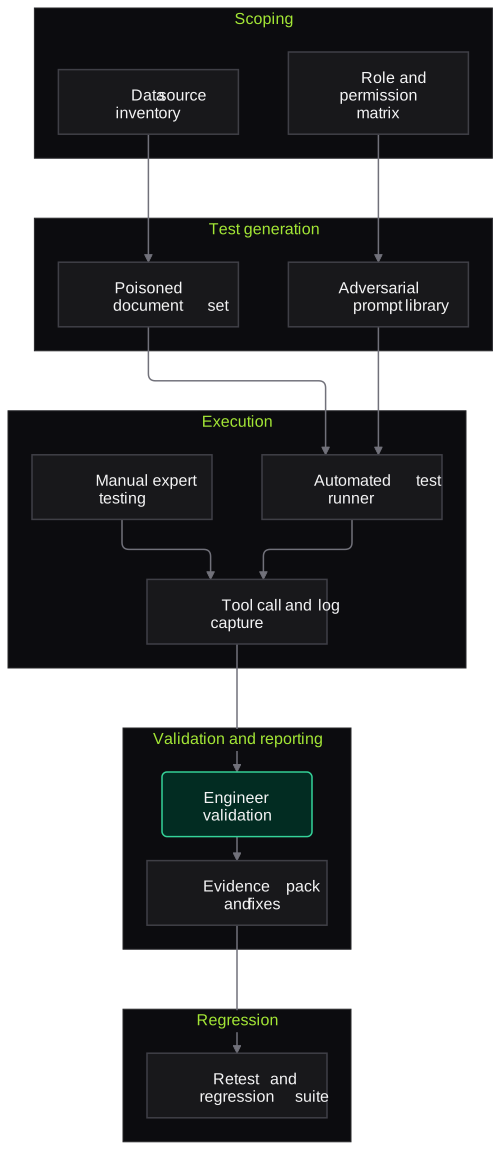
Architecture
- Scoping
- Asset and data-source inventory
- Role and permission matrix
- Rules of engagement with OT exclusions
- Test generation
- Adversarial prompt library for injection and jailbreaks
- Poisoned document set for indirect injection
- Role-based leakage test cases
- Execution
- Automated test runner against the copilot API or UI
- Manual expert testing
- Tool-call and log capture
- Validation and reporting
- Engineer validation and severity rating
- Evidence pack mapped to OWASP LLM Top 10
- Remediation guidance
- Regression
- Retest of fixed findings
- Regression suite for future releases
Inputs and outputs
Inputs
- Copilot architecture, prompts and tool definitions
- Data source list and access model
- Test accounts for each user role
- Staging or test environment access
- Existing security policies and OT network boundaries
Outputs
- Threat model and test plan
- Validated findings with severity, evidence and reproduction steps
- Mapping of findings to OWASP LLM Top 10 and MITRE ATLAS
- Remediation guidance for prompts, retrieval, permissions and monitoring
- Retest results and regression test pack
Where people stay in control
Our security engineers validate every automated finding before it reaches the report, and your IT, OT and data owners approve the scope and decide how to treat each risk. No test touches live OT control systems.
Integrations
- Copilot platforms such as Azure OpenAI, Microsoft Copilot Studio or custom LLM apps
- SAP, CMMS and MES APIs used as copilot tools
- SharePoint, network drives or PLM vaults used for retrieval
- Issue trackers such as Jira for findings
- CI pipelines for regression tests
Guardrails
- Testing only within agreed scope, accounts and time windows
- No write actions against production ERP, MES or OT systems
- Synthetic test data used in place of real customer drawings or personal data where possible
- Findings and evidence stored encrypted with restricted access
Compliance notes
- Findings are mapped to the OWASP Top 10 for LLM Applications and can feed risk records aligned with the NIST AI RMF and ISO/IEC 42001.
- For copilots near industrial control systems, scoping respects your IEC 62443 zones and conduits.
A typical pilot
Duration: 2 to 3 weeks
One copilot in a staging environment, such as a maintenance assistant connected to SAP PM and a manuals library, with two or three user roles.
Deliverables
- 01Rules of engagement and threat model
- 02Executed test plan with logs
- 03Validated findings report with remediation guidance
- 04Read-out session with IT, OT and the copilot team
- 05Retest of fixed findings
What we measure
- Test coverage
- Test cases executed per OWASP LLM category, data source and tool.
- Validated findings by severity
- Count of engineer-confirmed findings at each severity level.
- Leakage exposure
- Restricted documents or records reachable from each test role.
- Fix verification
- Status of each finding on retest after remediation.
Built on related work
LLM endpoint security scanner
Security platform (anonymised)
Workflow that scans Azure-hosted and custom HTTP LLM endpoints for prompt injection, jailbreaks and data leakage.
FAQs
01Will testing disrupt production?
No. We test in staging or with read-only test accounts, inside agreed time windows. Any test that could write to a real system is either run against a test instance or left out of scope.
02We use Microsoft Copilot, not a custom build. Is this still relevant?
Yes. Off-the-shelf copilots inherit your SharePoint and Teams permissions, so oversharing is a common finding. We test what each role can retrieve and whether connectors or plugins widen that.
03How is this different from a normal penetration test?
A normal test covers the web application and infrastructure. This review targets the model layer: prompts, retrieval, memory, tool calls and the way documents can steer the model. We can coordinate with your existing pentest provider.
04Can our OEM customers see the results?
The report includes an executive summary written so it can be shared with customers under NDA, while detailed reproduction steps stay internal.
Related use cases
- Manufacturing
Maintenance Log and SOP Assistant
A shop-floor assistant that answers technicians' questions from breakdown history, OEM manuals and SOPs, in Hindi or English, with the source page or work order behind every answer.
- Energy, Mining & Utilities
Security Review for OT/IT AI Assistants
Adversarial testing and architecture review for AI assistants that read historian data, manuals and work orders, covering prompt injection, unsafe advice, data leakage and tool permissions.
- SaaS & AI Product Companies
RAG Data-Leakage and Access-Control Testing
Test whether your RAG pipeline leaks documents across users, roles or tenants through retrieval, caching, citations or logs, using seeded canary documents and role-based test personas.
- Fintech & Payments
AI Agent Permission and Tool-Use Security Review
Find out what your AI agents can actually do: which tools, credentials and money-moving actions they reach, where approvals sit, and whether injected text can make them misuse tools.

Founded by Akhilesh Mittal. 8 years building a security platform for a New Zealand company. IIT ISM Dhanbad and IMT Ghaziabad. Builds production agentic AI.
Start with one line, one document or one region
Book a discovery call and we will pick a narrow pilot with your quality, finance or sales team, run it alongside your current process and report what we measured.