Rider and Driver Support Voice Agent
A Hindi and regional-language voice agent for delivery riders and truck drivers that handles address help, trip, payout and COD queries, and captures incidents for immediate control tower handover.
- Capability:
- Voice AI
- Industry:
- Logistics & Supply Chain
Who it is for
- Head of Fleet and Rider Operations
- Control Tower Manager
- Last-Mile Operations Manager
- Driver Partner Experience Lead
The problem
Last-mile riders and line-haul drivers call hubs, team leads and control towers all day: the address cannot be found, the customer is not answering, the app shows the wrong payout, the vehicle has broken down. Callers are on the road, often prefer Hindi or a regional language, and need answers fast, while control tower staff juggle the same questions across many phones.
Repetitive queries clog the helpline
Payout, incentive, COD deposit and app login questions take up agent time needed for real incidents.
Long waits on the road
Riders waiting for help at a customer's door, or drivers stuck at a checkpost, lose time and deliveries.
Incidents reported inconsistently
Accidents, breakdowns, thefts and detentions are reported by phone, and details are lost before they reach the right team.
Language and literacy gaps
Text-based in-app support does not suit riders and drivers who are more comfortable speaking in their own language.
What we build
We build a voice agent that riders and drivers reach from a helpline number or a button in their app. It identifies the caller by phone number, loads their current trip or route, and handles common questions directly: consignee contact attempts and address landmarks, payout and incentive breakdowns, COD deposit status and app troubleshooting. For breakdowns, accidents, theft or detentions it collects location and key details in a fixed sequence and transfers to a control tower agent at once with a summary. It speaks Hindi, Hinglish and the regional languages you need, and never changes payouts or trip assignments itself.
- Identifies the rider or driver and loads their active trip, route and recent payouts
- Answers payout, incentive, COD deposit and app login questions from your systems
- Helps with address issues using landmarks, consignee contact attempts and hub guidance
- Collects structured incident reports for breakdowns, accidents, theft and detentions
- Transfers urgent and safety-related calls to a control tower agent with a summary
- Works in Hindi, Hinglish and configured regional languages on noisy roadside audio
How it works
- 01Rider or driver callsThe caller uses the helpline number or app button and is identified by phone number.
- 02Classify the issueThe agent asks what is wrong and classifies it as a query, address help or an incident.
- 03Answer from systemsFor queries, it fetches trip, payout or COD data from your systems and explains it.
- 04Capture incidentsFor incidents, it captures location, vehicle, shipment and injury information in a fixed sequence.
- 05Hand over when neededSafety issues, disputes and unresolved queries go to a control tower agent with the summary.
- 06Log and follow upEach call is logged with its outcome, and tickets are created for teams such as payouts or claims.

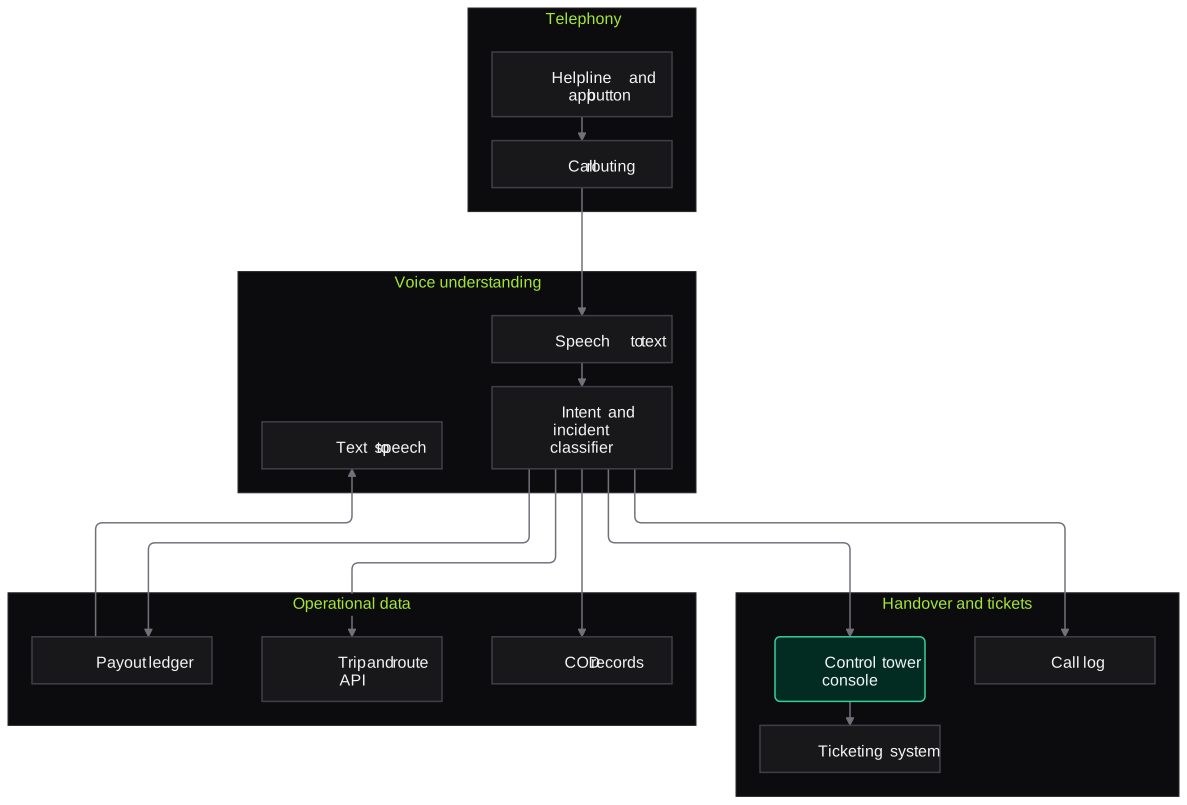
Architecture
- Telephony
- Helpline numbers and in-app call button
- Call routing and recording
- Voice understanding
- Speech-to-text for Hindi and regional languages
- Intent and incident classifier
- Text-to-speech in the caller's language
- Operational data
- Trip and route API from the TMS or rider app
- Payout and incentive ledger
- COD deposit records
- Handover and tickets
- Control tower console with call summary
- Ticketing system
- Call log and QA sampling
Inputs and outputs
Inputs
- Rider and driver master with phone numbers and preferred languages
- Active trips, routes and consignment details
- Payout, incentive and deduction records
- COD collection and deposit records
- Incident categories and escalation matrix
Outputs
- Resolved queries with call summaries
- Structured incident reports with location
- Warm transfers to the control tower with context
- Tickets for payouts, claims or fleet teams
- Call reason analytics by hub and language
Where people stay in control
Control tower staff take over every safety incident, dispute and unresolved call, with the agent's summary on screen. Payout corrections, trip reassignments and claims decisions are made by your teams.
Integrations
- TMS or rider app backend
- Payout and incentive system
- Cloud telephony or contact-centre platform
- Ticketing system such as Freshdesk or Zendesk
- WhatsApp Business API for follow-up messages
Guardrails
- Safety-related phrases trigger an immediate human transfer
- No changes to payouts, trips or COD records by the agent
- Callers can ask for a person at any point
- Personal data shared only with the verified caller
- Weekly sampled call reviews for answer quality
Compliance notes
- Call recordings and rider or driver data are processed in line with the DPDP Act 2023, with notice at the start of the call.
- Incident records support your duty-of-care and insurance processes; they do not replace statutory accident reporting.
A typical pilot
Duration: 4 weeks
One city or region and its rider helpline, starting with payout and COD queries plus incident capture with immediate handover.
Deliverables
- 01Call flows for the agreed intents in Hindi and one regional language
- 02Integration with trip and payout data
- 03Control tower handover console
- 04Pilot report on resolution and handover quality
- 05Roll-out plan by language and region
What we measure
- Resolution of in-scope queries
- Calls resolved without transfer, verified through sampled call reviews.
- Handover quality
- Control tower agents rate whether each summary was complete and correct.
- Speech recognition accuracy
- Transcripts of sampled calls compared with human transcription, per language.
- Time to reach help for incidents
- Time from call start to control tower pickup on incident calls.
FAQs
01Will riders actually use a voice agent?
Riders and drivers already call for help; the agent answers at once in their language and transfers when needed. The pilot measures repeat usage and transfer requests so you can judge acceptance.
02How does it cope with traffic noise?
Speech recognition is tested on real roadside and highway audio during the pilot. If the agent still cannot understand after a retry, it transfers to a person rather than guessing.
03Can it reassign a delivery or change an address?
It can pass address landmarks or reattempt requests to the hub, but it does not change assignments or records itself. Those actions stay with hub staff or your existing rules.
04Which languages can you support?
We start with Hindi and Hinglish and add regional languages such as Marathi, Tamil, Telugu, Kannada or Bengali based on your fleet. Each language is tested on real audio before go-live.
Related use cases
- Logistics & Supply Chain
Delivery Status Agent (Voice + WhatsApp)
Answer where-is-my-shipment calls and WhatsApp messages from consignees and shippers, arrange reschedules and NDR reattempts within your rules, and hand complaints and disputes to your team.
- Logistics & Supply Chain
Proof of Delivery Capture and Verification
Check every POD photo or scan for consignment number, date, signature, stamp and remarks, match it to the shipment in your TMS, and flag short, damaged or doubtful deliveries before billing.
- Logistics & Supply Chain
Security Testing for Customer-Facing Logistics AI Agents
Adversarial testing of tracking chatbots, WhatsApp bots and voice agents for shipment data leakage, tracking-number enumeration, prompt injection and unsafe actions such as unauthorised redirects.
- Telecom & Contact Centres
Multilingual Inbound Voice Agent for L1 Support
A voice agent that answers routine L1 calls in Hindi, Hinglish and regional languages, resolves what it safely can through your systems and hands the rest to an agent with full context.

Founded by Akhilesh Mittal. 8 years building a security platform for a New Zealand company. IIT ISM Dhanbad and IMT Ghaziabad. Builds production agentic AI.
Start with one lane, one carrier or one hub
Book a discovery call to pick a narrow pilot on your own PODs, freight bills or customer calls, and compare the results with your team's current process.