Admission Document Verification
Check mark sheets, transfer and migration certificates, category certificates and ID proofs against your eligibility rules, and send applicants a precise deficiency list instead of a vague rejection.
- Capability:
- Document Intelligence
- Industry:
- Education & Coaching
Who it is for
- Registrar
- Head of Admissions Office
- Director of Admissions
- School Principal
The problem
Admission files arrive in a rush: Class 10 and 12 mark sheets from different boards, entrance scorecards, transfer and migration certificates, category, income and domicile certificates, disability certificates and ID proofs. Staff check each one by eye against eligibility rules that change by programme and quota, often during counselling rounds with fixed reporting deadlines.
Every board's mark sheet looks different
CBSE, CISCE and each state board use different layouts, grading systems and subject codes, so working out the right aggregate takes time.
Validity rules are easy to miss
Category, income and non-creamy-layer certificates are often valid only for a particular period or financial year, and expired documents slip through.
Name and date mismatches
Spelling differences, initials and date-of-birth discrepancies across documents need judgement, not automatic rejection.
Vague deficiency notices
Applicants get a generic documents-incomplete message, call the office repeatedly and risk missing the reporting window.
What we build
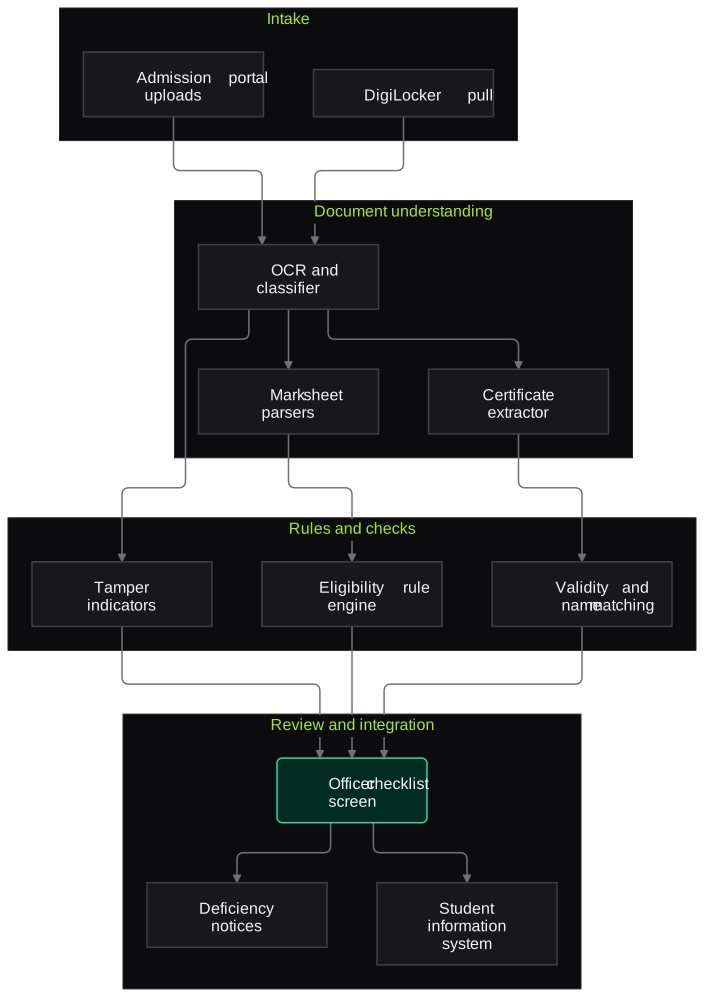
We build a verification pipeline behind your admission portal. It classifies each uploaded document, extracts the fields that matter, such as board, roll number, subject-wise marks, result status, certificate type, issuing authority and validity, and cross-checks them against each other and against the programme's eligibility rules. Documents pulled from DigiLocker are marked as issuer-sourced. Signs of editing, such as altered figures or mismatched fonts, are flagged for scrutiny. Admissions staff see one checklist per applicant with every field linked to its source page, and the applicant receives a specific list of what is missing or needs correcting.
- Classifies mark sheets, scorecards, TCs and migration, category, income, domicile and disability certificates
- Extracts subject-wise marks and computes aggregates using each board's grading rules
- Checks certificate validity dates and issuing authority against programme and quota rules
- Matches names, parents' names and dates of birth across documents, tolerating spelling variants
- Flags signs of editing, such as inconsistent fonts or altered figures, for manual scrutiny
- Generates a precise deficiency list for the applicant in English or Hindi
How it works
- 01Applicant uploadsDocuments come through the admission portal or DigiLocker and are grouped under the application number.
- 02Classify and extractEach document is identified and its key fields extracted with confidence scores and source-page links.
- 03Cross-checkNames, dates, marks and certificate validity are compared across documents and against the eligibility rules for the chosen programme and quota.
- 04Route exceptionsLow-confidence fields, rule failures and possible tampering go to an admissions officer.
- 05Officer decidesThe officer verifies against the original, records a decision and adds any comment for the applicant.
- 06Notify and updateThe applicant gets a status update with a specific deficiency list, and the student information system is updated.

Architecture
- Intake
- Admission portal upload connector
- DigiLocker document pull with applicant consent
- Application-level document grouping
- Document understanding
- OCR with layout detection
- Document classifier
- Board-specific mark sheet parsers
- LLM extractor for certificates
- Rules and checks
- Eligibility and quota rule engine
- Certificate validity checks
- Cross-document name and date matching
- Tamper indicators
- Review
- Applicant checklist screen with source links
- Officer decision log
- Communication and integration
- Deficiency notice generator
- Student information system adapter
- Email, SMS and WhatsApp notifications
Inputs and outputs
Inputs
- Class 10 and 12 mark sheets and passing certificates
- Entrance exam scorecards or rank letters
- Transfer, migration and character certificates
- Category, income, domicile and disability certificates
- ID proof with masked Aadhaar
- Programme eligibility and quota rules
Outputs
- Applicant checklist with every field linked to its source
- Computed aggregates and eligibility result for officer confirmation
- Flags for expired certificates, mismatches and possible tampering
- Applicant-specific deficiency notices
- Status updates in the student information system
Where people stay in control
Admissions officers decide every exception and sign off clean files in batches. The system never rejects an applicant; it tells staff what to look at and tells applicants exactly what to fix.
Integrations
- Admission portal or application form system
- DigiLocker, where your institution is registered as a requester
- Student information system or ERP
- Email, SMS and WhatsApp Business API
- Document management or cloud storage
Guardrails
- No automatic rejection; every failure becomes an officer task
- Aadhaar handled per UIDAI rules and stored only in masked form
- Category and disability documents visible only to authorised staff
- Every extracted value linked to its source page
- Eligibility rules versioned so any decision can be explained later
Compliance notes
- School and many undergraduate applicants are minors; designed to support DPDP Act 2023 requirements on parental consent, purpose limitation and retention.
- Category, income and disability documents are sensitive; access controls and view logs help evidence that only authorised staff saw them.
A typical pilot
Duration: 3 weeks
One programme in one admission round, with files verified by the system and by your staff in parallel.
Deliverables
- 01Document types and eligibility rules configured for the pilot programme
- 02Verification pipeline running on real, consented applications
- 03Officer checklist screen and deficiency notice templates
- 04Accuracy and exception report
- 05Roll-out plan for the next admission cycle
What we measure
- Field extraction accuracy
- Compared with values verified by admissions staff on the same files.
- Exceptions confirmed as genuine
- Officer outcome on each flag: genuine issue, false alarm or needs more information.
- Officer time per file
- Timed on sample files with and without the checklist screen.
- Repeat applicant queries
- Calls and emails about document status before and during the pilot.
FAQs
01Can it read mark sheets from every board?
We start with the boards that make up most of your applicants and add parsers for others. Unusual layouts are still handled by the general model, with lower-confidence fields sent to an officer.
02Does it detect fake certificates?
It flags signs of editing and inconsistencies, and documents pulled from DigiLocker can be treated as issuer-sourced. It cannot prove a paper certificate is genuine, so your verification process with the issuing authority still applies.
03How is applicant data protected?
Data stays in your cloud account or an India region, Aadhaar is masked, sensitive certificates have restricted access and every view is logged. Retention follows your admission policy.
04Can the rules change between rounds?
Yes. Eligibility and quota rules are configuration, versioned by round, so the admissions team can update them without code changes and earlier decisions remain explainable.
Related use cases
- Education & Coaching
Admission Enquiry Voice Agent
Answer admission calls in Hindi, Hinglish and English from your approved prospectus and fee data, book scholarship tests and campus visits, and hand families to a counsellor when it matters.
- Education & Coaching
Lead Nurture for Counselling Funnels
Score and route enquiries from ads, forms and scholarship-test registrations, send consented WhatsApp and email follow-ups to parents and adult learners, and give counsellors a briefed call list.
- Education & Coaching
Fee Reminder Agent (Voice + WhatsApp)
Remind parents of upcoming and overdue fee instalments on WhatsApp and by voice in their language, share a UPI link, confirm payments and route hardship requests to the accounts office.
- Banking
Account Opening Document Verification
Check OVDs, PAN, masked Aadhaar, photographs and entity documents in an account opening file against each other and against CKYC, with mismatches routed to an officer.

Founded by Akhilesh Mittal. 8 years building a security platform for a New Zealand company. IIT ISM Dhanbad and IMT Ghaziabad. Builds production agentic AI.
Start with one test cycle or one admission season
Tell us where the backlog is worst, whether that is test evaluation, admission documents or parent calls. We will scope a short pilot on your own data and walk you through what it found before any wider roll-out.