Multilingual Voice Agent for Banking Service Requests
An inbound voice agent that authenticates callers and handles card blocking, statements, cheque books and status queries in Hindi, Hinglish and regional languages, with clean handover.
Who it is for
- Head of Contact Centre
- Head of Digital Channels
- Chief Information Security Officer
- Customer Experience Head
The problem
Most calls to a bank contact centre are routine: block a card, request a statement, order a cheque book or check a pending UPI dispute. Menu-driven IVRs handle these poorly for callers who think in Hindi, Marathi or Tamil, so they wait for an agent or visit the branch, and agents spend their day on requests that follow a script.
IVR menus that callers abandon
Deep keypad menus in two languages do not match how customers describe their problem, and many press zero for an agent at the first chance.
Language coverage limited by staffing
Regional-language desks are small, so callers outside the main languages face the longest waits.
Inconsistent caller authentication
Agents verify callers in different ways, and social engineers exploit that variation to attempt account takeover.
Context lost at handover
When a call moves to an agent, the customer repeats everything because the IVR captured nothing useful.
What we build
We build a voice agent that answers on your existing telephony and speaks with callers in Hindi, Hinglish, English and the regional languages you choose. It identifies the caller from the registered mobile number and completes authentication through your existing methods, such as a T-PIN or OTP entered on the keypad and checked by your authentication service. Once the caller is authenticated, it handles approved service intents through your bank's APIs: hotlisting a card, sending a statement to the registered email, ordering a cheque book or reading out the status of a complaint. Anything outside the approved list, and any sign of distress or fraud, goes to a human agent with a summary on screen.
- Speech recognition and replies in Hindi, Hinglish, English and selected regional languages, with mid-call language switching
- Caller identification and step-up authentication through the bank's existing T-PIN or OTP services
- Approved service intents executed through bank APIs, such as card hotlisting, statements and cheque book requests
- Status read-outs for complaints, UPI disputes and service requests from the CRM
- Fraud and distress cues trigger immediate transfer to a human agent
- Warm handover with transcript summary and authentication status on the agent desktop
How it works
- 01Answer and detect languageThe agent greets the caller, detects the preferred language and lets the caller switch at any point.
- 02Identify and authenticateThe registered mobile number identifies the customer, and a keypad T-PIN or OTP checked by bank systems completes authentication.
- 03Understand the requestThe caller's words are mapped to the approved intent list, and an unclear request gets one clarifying question.
- 04Check whether it can actIf the intent is approved and the authentication level is sufficient, the agent proceeds; otherwise it transfers.
- 05Execute through bank APIsThe agent calls the relevant service API, confirms the action with the caller and sends an SMS confirmation.
- 06Hand over or closeTransfers carry a summary to the human agent, and every call is logged with transcript and outcome.

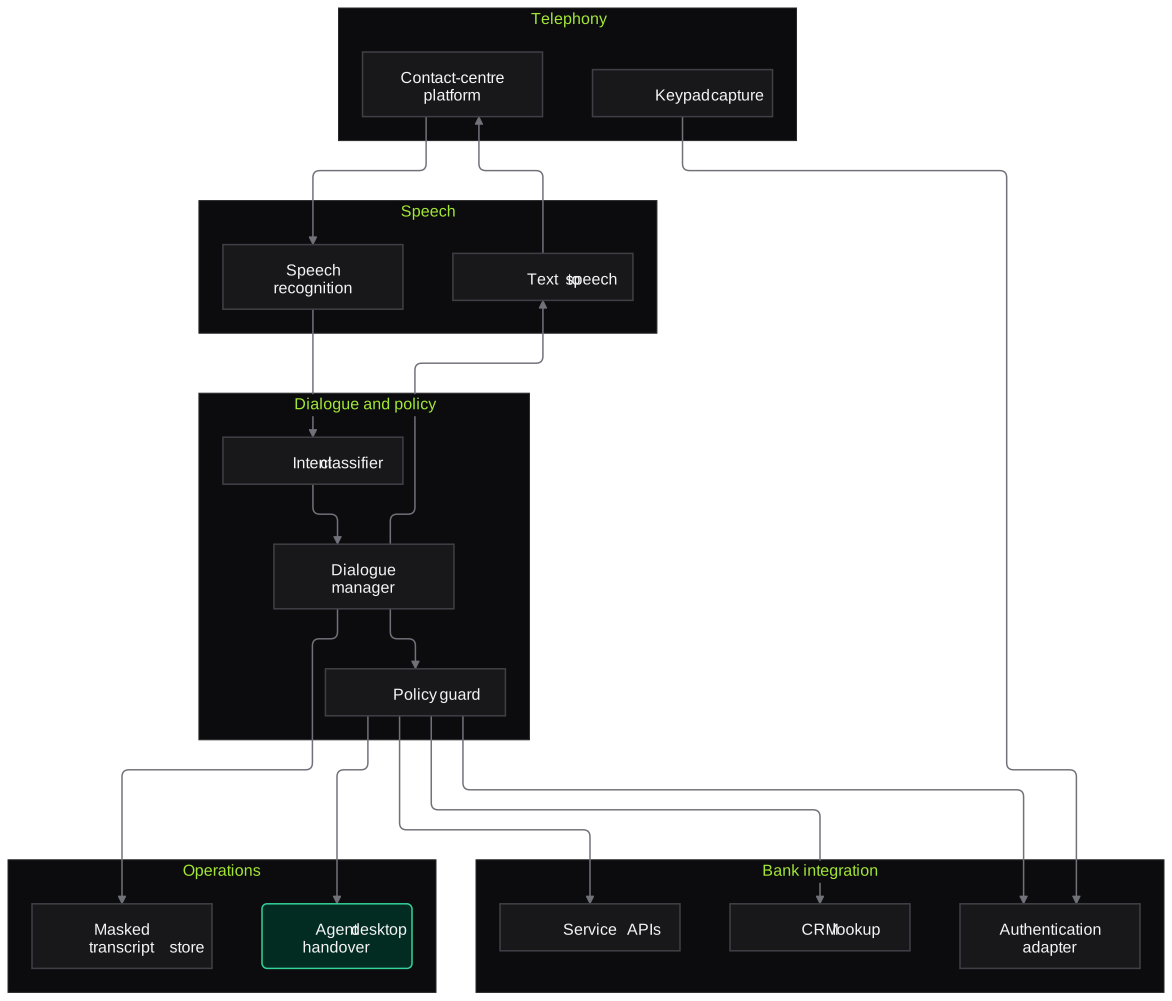
Architecture
- Telephony
- SIP trunk or contact-centre platform integration
- Keypad capture for T-PIN and OTP entry
- Call recording per bank policy
- Speech
- Streaming speech recognition for Indian languages
- Text-to-speech voices per language
- Language and code-mix detection
- Dialogue and policy
- Intent classifier with approved intent list
- LLM dialogue manager with scripted confirmations
- Policy guard for authentication level and topic limits
- Bank integration
- Authentication service adapter
- Card, statement and cheque book service APIs
- CRM status lookup
- Operations
- Agent desktop handover summary
- Transcript store with PII masking
- Call quality dashboard
Inputs and outputs
Inputs
- Inbound calls through the bank's telephony or contact-centre platform
- Registered mobile number and customer profile from the CRM
- Approved intent list and call scripts per language
- Bank service APIs for cards, statements, cheque books and requests
- Complaint and service request status from the CRM
Outputs
- Completed service requests with SMS confirmations
- Call transcripts with PII masked
- Handover summaries for human agents
- Intent, completion and transfer reports by language
- Calls flagged for possible fraud or distress cues
Where people stay in control
Human agents take every call outside the approved intents, every caller who asks for a person and every call with fraud or distress cues. Contact-centre supervisors review sampled transcripts each week and approve any change to intents or scripts.
Integrations
- Contact-centre platform or SIP telephony, such as Genesys, Avaya or Ameyo
- Bank authentication service for T-PIN or OTP
- Card management and core banking service APIs
- CRM for service requests and complaints
- SMS gateway for confirmations
Guardrails
- Never asks callers to speak an OTP, PIN or CVV aloud; keypad entries pass straight to bank authentication
- Account actions allowed only at the authentication level defined for each intent
- Topic limits: service requests only, with no advice on investments, loans or tax
- Immediate transfer on fraud cues, distress or repeated misunderstanding
- PII masked in transcripts and logs, with retention set by bank policy
Compliance notes
- Designed to support DPDP Act 2023 obligations through notice at call start, purpose-limited processing and masked transcripts.
- Call recording, retention and vendor controls follow the bank's policies under RBI directions on IT governance and outsourcing.
A typical pilot
Duration: 4 weeks
Three to five high-volume service intents, such as card hotlisting, statement requests and cheque book orders, in Hindi and one regional language, on a test number before a small share of live traffic.
Deliverables
- 01Intent list, scripts and authentication rules agreed with contact-centre and security teams
- 02Working voice agent on your telephony in a test environment
- 03Agent desktop handover summary
- 04Transcript review and quality report
- 05Production plan with language roll-out and cost per call
What we measure
- Task completion for approved intents
- Calls where the requested action completed correctly, verified against bank system logs.
- Speech recognition quality by language
- Transcript accuracy checked by native speakers on a sample of calls.
- Transfer reasons
- Each transfer tagged by cause, such as out-of-scope request, authentication failure or misunderstanding.
- Caller effort
- Turns per completed request, and post-call survey responses where your bank runs them.
FAQs
01Which languages are supported?
Hindi, Hinglish and English as standard, with Marathi, Tamil, Telugu, Kannada, Bengali, Gujarati and others added based on your customer base. Each language is tested with native speakers before going live.
02How is caller authentication handled?
Through your existing methods. The agent identifies the caller from the registered number and uses your T-PIN or OTP service through keypad entry, so secrets never pass through speech recognition.
03Can it work alongside our current IVR?
Yes. It can sit behind an IVR menu option, replace the menu on selected numbers or take overflow traffic. We connect through your contact-centre platform's standard interfaces.
04What happens when it gets something wrong?
It confirms every action before executing it, and if it fails to understand twice it transfers to an agent. Misunderstandings are tagged in transcripts and reviewed weekly to improve the intents.
Related use cases
- Banking
Customer Complaint Triage and Routing
Classify complaints from email, branches, social media and RBI CMS, spot urgent cases such as unauthorised transactions, route them to resolver teams and draft acknowledgements.
- Banking
Red-Teaming for Bank Chatbots and Voice Agents
Adversarial testing of bank chatbots and voice agents for prompt injection, data leakage, account-takeover social engineering and unsafe advice, in English, Hindi and Hinglish.
- Banking
Cross-Sell Lead Scoring and Personalised Outreach
Score existing customers for products they are likely to need from consented banking data, and draft compliant, personalised outreach that relationship managers review before sending.
- Telecom & Contact Centres
Multilingual Inbound Voice Agent for L1 Support
A voice agent that answers routine L1 calls in Hindi, Hinglish and regional languages, resolves what it safely can through your systems and hands the rest to an agent with full context.

Founded by Akhilesh Mittal. 8 years building a security platform for a New Zealand company. IIT ISM Dhanbad and IMT Ghaziabad. Builds production agentic AI.
Pick one banking process and test it with evidence
Book a discovery call to choose a narrow pilot, from KYC file checks to voice-agent red-teaming, and see measured results on your own documents before any wider roll-out.