Cheque Image and Signature Mismatch Flagging
Compare inward CTS cheque images with specimen signatures, mandates and Positive Pay data, and rank cheques by risk so verification officers look first where it matters.
- Industry:
- Banking
Who it is for
- Head of Clearing Operations
- Inward Clearing Verification Officer
- Fraud Risk Manager
- Head of Branch Operations
The problem
In cheque truncation the drawee bank sees only images, and must confirm signature, amount, date and mandate before the return deadline. As CTS moves to continuous clearing with settlement on realisation, that window gets shorter, while officers still compare signatures by eye against scanned specimen cards.
Signature checks against poor specimens
Specimen signatures scanned years ago, sometimes from branch cards, make visual comparison slow and subjective.
Mandate and joint-account rules
Cheques on joint and corporate accounts need the right combination of signatories, which officers must look up for each item.
Amount and date errors
Mismatches between amount in words and figures, stale or post-dated cheques and alterations are easy to miss at volume.
Uniform effort on uneven risk
Every cheque gets similar attention, although high-value items, new payees and long-inactive accounts carry far more risk.
What we build
We build a verification assistant for inward clearing. For each cheque image it reads the MICR band, date, payee and the amount in figures and words, and locates the signature area. A signature comparison model scores similarity against the specimens in your signature repository, and a rules layer checks the operating mandate, account status, stop-payment instructions, cheque series and any Positive Pay details the customer submitted. Cheques are ranked by combined risk and value, and the verification officer sees the cheque, the specimens and every flag side by side. The officer decides to pass or return every item; the assistant never returns a cheque on its own.
- Reads MICR, date, payee and amounts in figures and words from CTS images, including handwriting
- Signature similarity scoring against one or more specimens per signatory
- Mandate checks for joint, either-or-survivor and corporate signatory rules
- Positive Pay, stop-payment, cheque series and account status checks
- Detection of alterations, overwriting and amount-in-words mismatches
- Risk-ranked queue combining value, flags and account context
How it works
- 01Receive inward imagesInward clearing images and data arrive from the CTS interface into the bank's inward processing system.
- 02Read the chequeOCR and handwriting recognition read the date, payee, amounts and MICR fields, and the signature region is located.
- 03Compare and checkSignatures are scored against specimens, and mandate, Positive Pay, stop-payment and account status checks run.
- 04Rank by riskEach cheque gets a risk band with reasons, combining flags, value and account context.
- 05Officer verificationOfficers review high-risk items first with cheque and specimens side by side, and record pass or return with a reason code.
- 06Return and learnDecisions flow back to the inward system, and confirmed mismatches feed periodic threshold reviews.

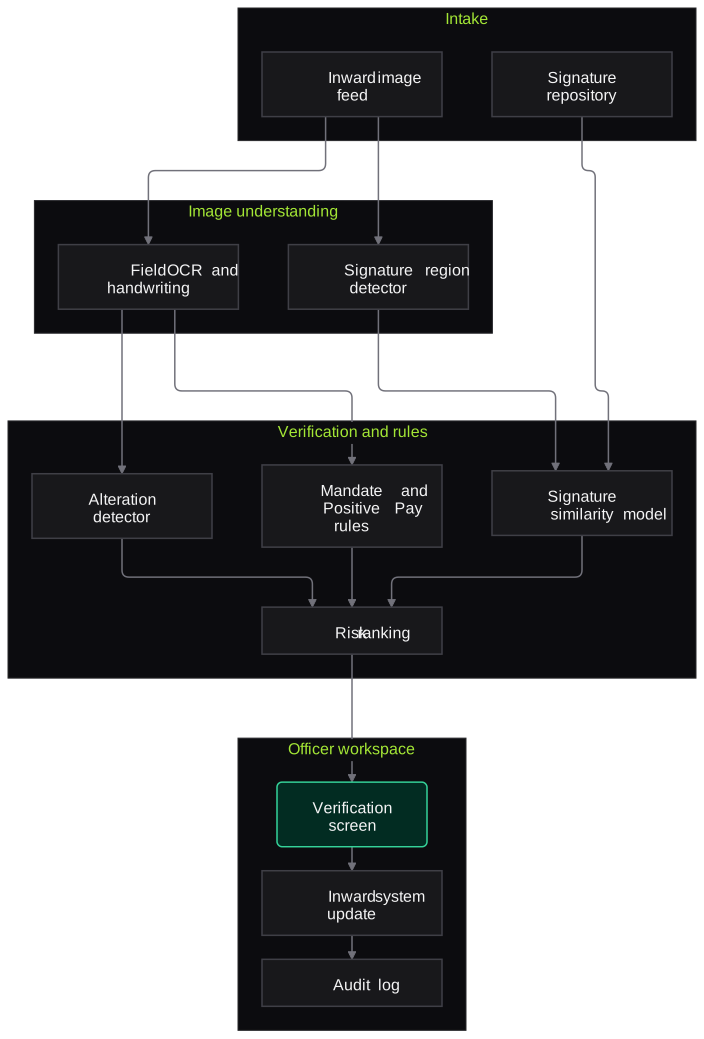
Architecture
- Intake
- Inward clearing image and data feed
- Signature repository and account master lookup
- Image understanding
- Image quality check
- Field OCR and handwriting recognition
- Signature region detection
- Verification models
- Signature similarity model
- Alteration and overwriting detector
- Amount words-figures consistency check
- Rules and ranking
- Mandate and account status rules
- Positive Pay and stop-payment matcher
- Risk ranking with reason codes
- Officer workspace
- Side-by-side verification screen
- Pass or return with reason codes
- Audit log
Inputs and outputs
Inputs
- Inward clearing cheque images, front and back
- MICR and presentment data from the clearing interface
- Specimen signatures and operating mandates
- Positive Pay submissions and stop-payment instructions
- Account status and issued cheque series from core banking
Outputs
- Extracted cheque fields with confidence
- Signature similarity scores with specimen references
- Flags for mandate, alteration, date, amount and Positive Pay mismatches
- Risk-ranked verification queue
- Officer decisions with reason codes and audit trail
Where people stay in control
Verification officers make every pass or return decision, with high-risk items shown first. Signature similarity is a decision aid; the bank's signature verification policy and the officer's judgement prevail.
Integrations
- Inward clearing or CTS processing system
- Core banking for account status, mandates and cheque series
- Signature verification repository
- Positive Pay data from the bank's channels
- Fraud case management system
Guardrails
- No automatic returns; officers decide every cheque
- Return reason codes always chosen by the officer
- Thresholds tuned per customer segment and reviewed with fraud risk
- Images and account data stay inside the bank's environment
- Score drift monitored when specimen quality or scanner sources change
Compliance notes
- Works within the bank's CTS procedures and RBI's Positive Pay arrangements; the drawee bank's verification responsibility stays with its officers.
- Supports RBI IT governance expectations by processing images on bank-controlled infrastructure.
A typical pilot
Duration: 4 weeks
Historical inward clearing images from one processing centre, including known returned and fraud items, scored offline and compared with officer decisions.
Deliverables
- 01Field extraction and signature scoring on historical images
- 02Mandate and Positive Pay rule set
- 03Officer verification screen prototype
- 04Comparison report against officer decisions and known fraud cases
- 05Production plan aligned with your clearing timelines
What we measure
- Signature mismatch detection
- Known returned-for-signature and fraud items placed in the high-risk band, measured on historical data.
- False alert load
- Genuine cheques placed in the high-risk band, reviewed with officers.
- Field reading accuracy
- Extracted date, amount and payee compared with officer-verified values.
- Verification time per item
- Timed for officers using the side-by-side screen against their current process.
FAQs
01Can the model return a cheque?
No. It ranks and flags. Officers decide pass or return and choose the reason code, as your clearing procedures require.
02Our specimen signatures are old scans. Will it still work?
Specimen quality affects accuracy, so the pilot reports results by specimen quality and lists accounts where re-capturing the specimen would help. Comparisons against poor specimens are marked as low confidence rather than scored with false certainty.
03Does this fit within clearing deadlines?
Scoring runs as images arrive, before officers start verification, so it adds no step to the critical path. We size the infrastructure against your peak inward volumes during the pilot.
04Where are cheque images processed?
On infrastructure the bank controls, either on-premise or in its private cloud. Images and signature data do not leave that environment.
Related use cases
- Banking
Account Opening Document Verification
Check OVDs, PAN, masked Aadhaar, photographs and entity documents in an account opening file against each other and against CKYC, with mismatches routed to an officer.
- Banking
Customer Complaint Triage and Routing
Classify complaints from email, branches, social media and RBI CMS, spot urgent cases such as unauthorised transactions, route them to resolver teams and draft acknowledgements.
- Banking
Branch Queue and Footfall Analytics
Turn existing branch CCTV into anonymous counts of footfall, queue length and counter wait times, so branch and regional managers can plan staffing and act on long queues.
- Fintech & Payments
Selfie-to-ID Face Match and Document Tamper Checks
Compare a live selfie with the photo on an ID, check liveness and spot edited or replayed ID images, sending borderline cases to a reviewer with highlighted evidence.

Founded by Akhilesh Mittal. 8 years building a security platform for a New Zealand company. IIT ISM Dhanbad and IMT Ghaziabad. Builds production agentic AI.
Pick one banking process and test it with evidence
Book a discovery call to choose a narrow pilot, from KYC file checks to voice-agent red-teaming, and see measured results on your own documents before any wider roll-out.